
META: A Win-Win Position
Mega-Cap Opportunity Too Good to Pass Up

Disclaimer
This article is for informational and educational purposes only and is not intended as financial, investment, or trading advice. I am not a registered investment advisor. All opinions and projections are my own and based on publicly available information.
Investing in securities, especially in the space sector, involves significant risk of loss. Past performance is not indicative of future results. You should conduct your own due diligence and consult a qualified financial advisor before making any investment decisions.
The author and this blog shall not be held liable for any losses or damages resulting from the use of this information. Always verify data independently.
How many hedge funds or other investors failed to buy Alphabet early last year because analysts claimed they were supposedly ‘way behind OpenAI?’ Or many failed to buy Amazon three months ago because analysts claimed they were ‘spending too much on infrastructure?’
I believe investors are having the same undeserved pessimism regarding Meta Platforms (META), and eventually its stock price will catch up to its underlying business performance.
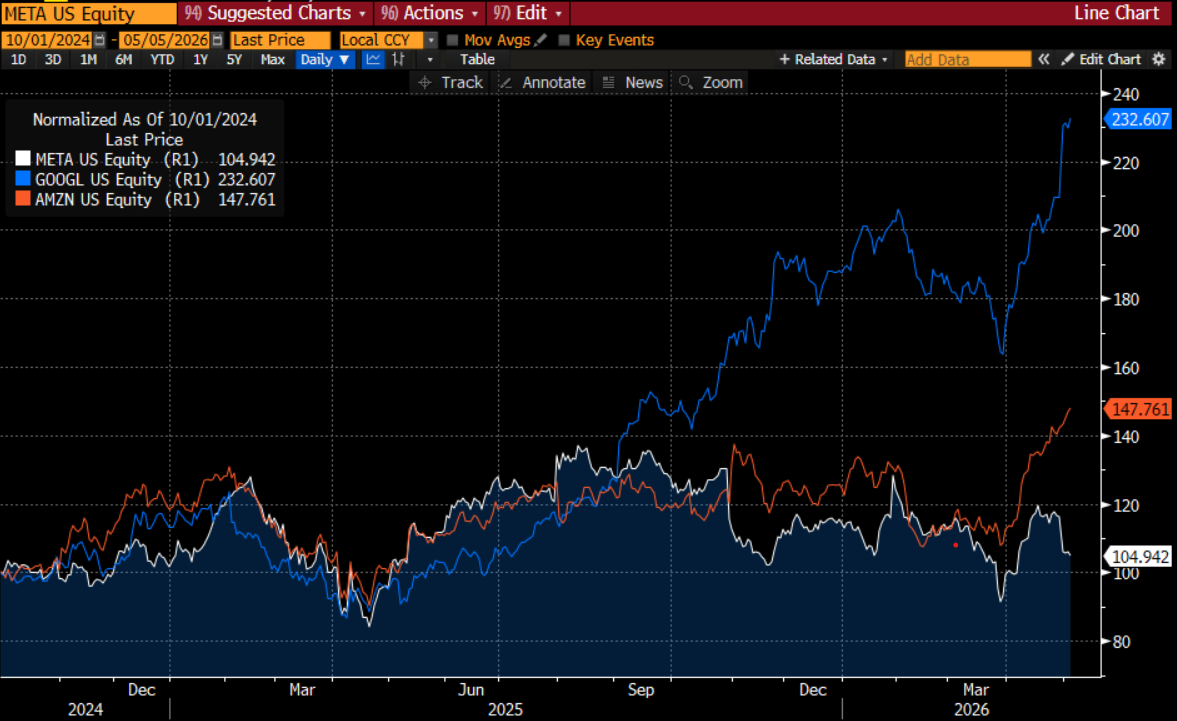
Analysts believe Meta is spending too much on building out infrastructure for its AI ambitions, and at a first glance it’s easy to believe the story. Meta has gone from a free cash flow machine — generating $43 billion in 2023 when the company was valued at only $879 billion (an incredible 5% free cash flow yield while revenue was growing 15%) — to projecting almost no free cash flow next year on a $1.5 trillion valuation.
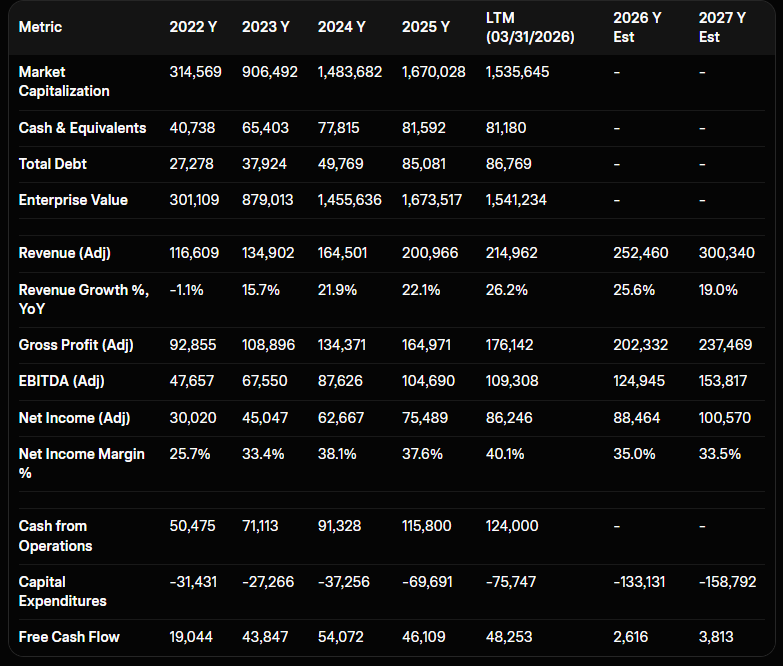
However, Meta’s revenue growth has actually accelerated since they started this capital expenditure buildout. This gets to the key point of why analysts are wrong. Instead of viewing Meta as recklessly spending, it seems Meta is in a true win-win scenario. Either their AI ambitions work out and all of this spending proves profitable, or if the spending doesn’t prove as useful as initially hoped, they can cut their capex spending, repurpose the surplus GPUs to serve better ads, and return to being the old free cash flow machine again.
As CEO Mark Zuckerberg has said himself in Meta’s Q3 2025 Earnings Call (October 29, 2025):
“...any compute that we don’t need for that, we feel pretty good that we’re going to be able to absorb a very large amount of that to just convert into more intelligence and better recommendations in our family of apps and ads in a profitable way.If it takes longer [for the bigger AI ambitions], then we’ll use the extra compute to accelerate our core business, which continues to be able to profitably use much more compute than we’ve been able to throw at it.”
Personally, I’m excited about Meta’s AI opportunity — not even mentioning the upside with their smart glasses business. While Anthropic has pulled ahead of OpenAI in revenue run-rate by focusing heavily on enterprise customers (and now OpenAI is chasing them in that direction), Meta brings something unique: the budget, the world-class advertising know-how, massive consumer data moat, and distribution to billions of users. This gives them a strong shot at building a popular consumer-focused AI product that others are largely ignoring.
Mark Zuckerberg has said that this is their current ambition in Meta’s Q1 2026 Earnings Call (April 29, 2026):
“...I don’t hear any other labs out there talking about how they’re building an AI that’s really good at shopping… These are all elements of the personal super intelligence vision… if what you want [AI] to do is empower individuals and build a world where the AI is in service to individual’s goals, then that is what we are going to build, and I think it’s going to be incredibly valuable.”
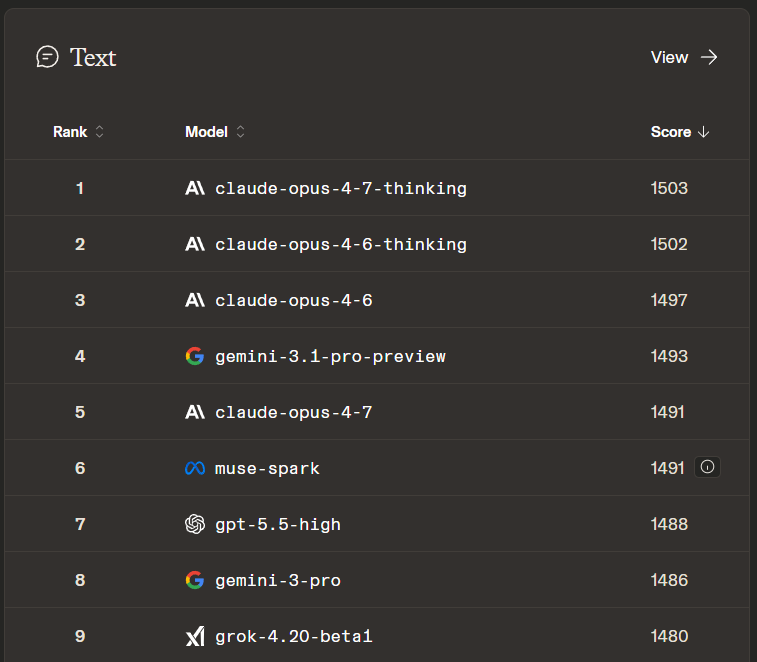
They already are showing signs of success with their first AI model under the new team, ‘Meta Muse Spark,’ which is ranked competitively with the most state-of-the-art labs across text, code, and vision benchmarks.
Meta has not succeeded with every bet (see Reality Labs), but they have repeatedly shown they know when to cut losses. I believe analysts are too focused on the up front costs right now while missing that the people at Meta are very sharp and will either succeed or pivot decisively.
Meta is valued far cheaper than it’s Mega Cap peers:
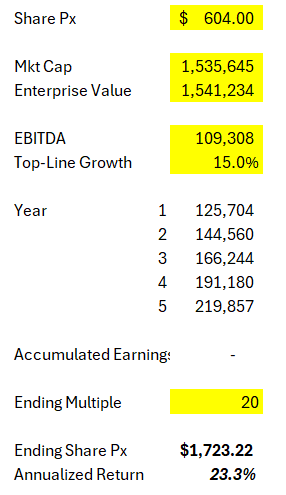
Doing simple back-of-the-envelope math, even assuming zero accumulated earnings, if Meta can grow earnings at just 15% per annum for the next five years and is then valued at a 20x P/E ratio, that should equate to around $1723/share, a 23% compound annual growth rate. That’s a far higher number than I get from doing a similar analysis on Microsoft, Alphabet or Amazon.
Meta is a worldwide leader in social media with 3.5 billion daily active users. They have some of the best algorithms for serving content and advertisements, which drives more engagement, more data, and even better content and ads in a virtuous cycle. It’s easy to see how this core business can benefit from the AI spend one way or another. They are the definition of an aggregator with durable competitive advantages — and I believe they are putting themselves in a genuine win-win position with AI.